Publications
Research spanning robust machine learning, audio and speech learning, and generative-model security.
2026
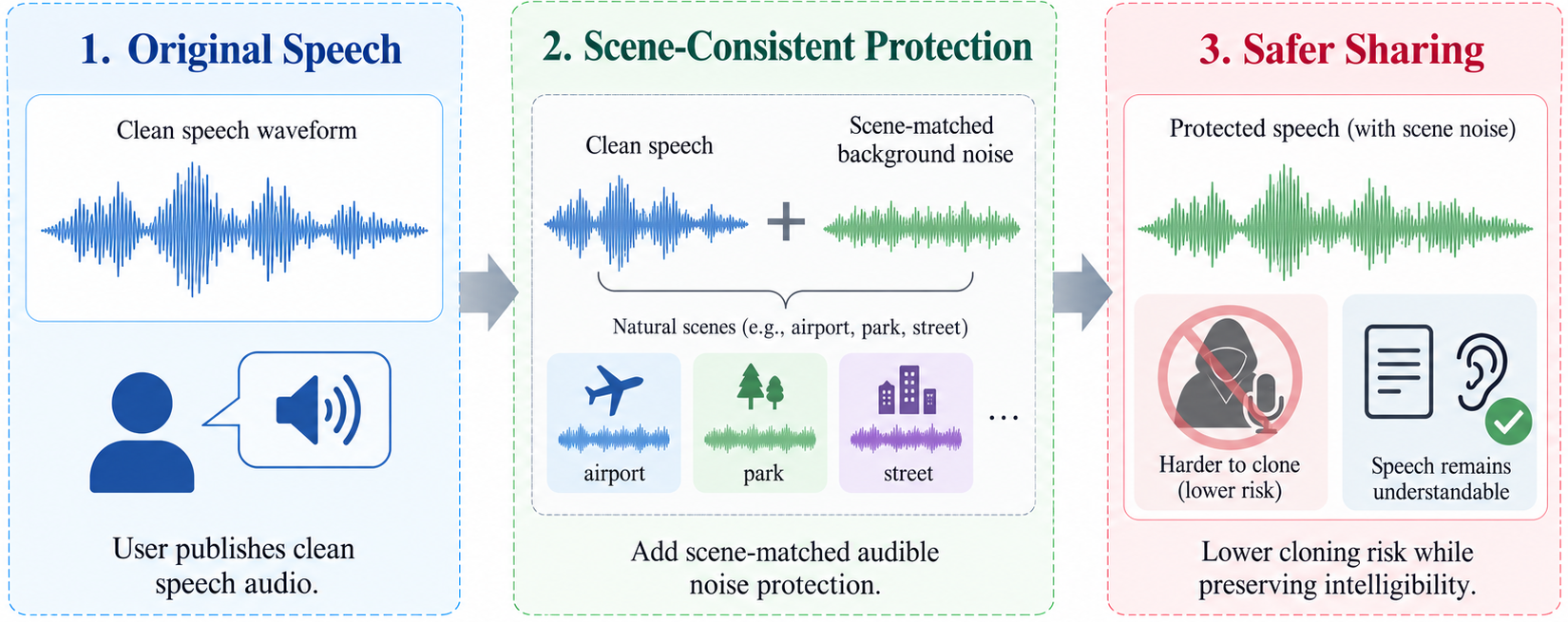
SceneGuard: Training-Time Voice Protection with Scene-Consistent Audible Background Noise
Rui Sang, Yuxuan Liu
AAAI 2026 Workshop Accepted · First author
SceneGuard is a training-time voice protection method that uses scene-consistent audible background noise to defend speech recordings against unauthorized voice cloning.
SceneGuard: Training-Time Voice Protection with Scene-Consistent Audible Background Noise
Rui Sang, Yuxuan Liu
AAAI 2026 Workshop Accepted · First author
SceneGuard is a training-time voice protection method that uses scene-consistent audible background noise to defend speech recordings against unauthorized voice cloning.
2025
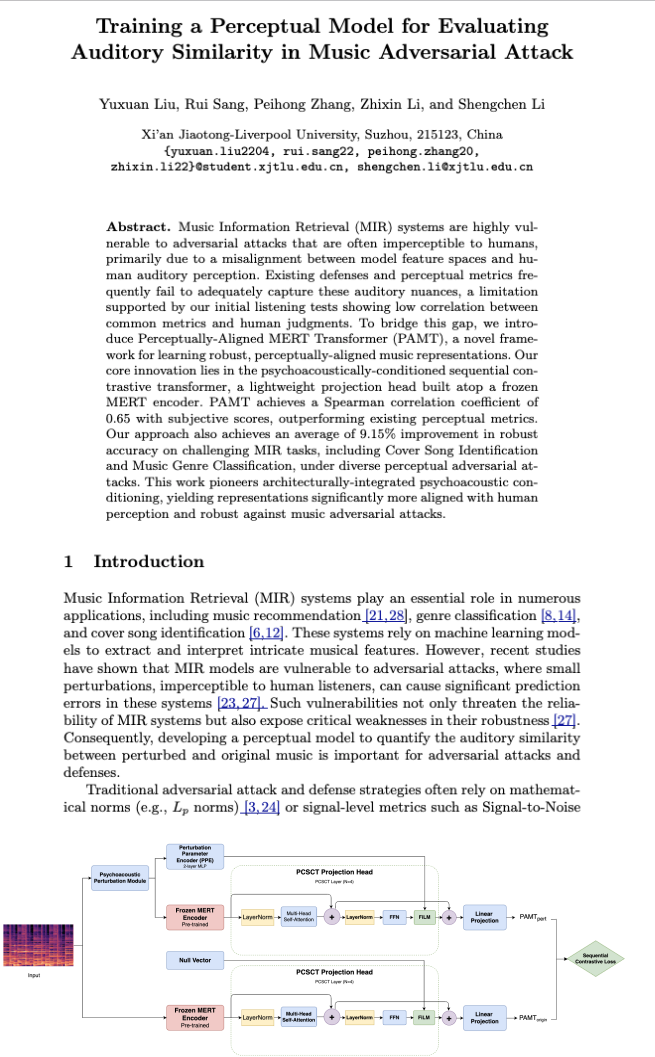
Training a Perceptual Model for Evaluating Auditory Similarity in Music Adversarial Attack
Yuxuan Liu, Rui Sang, Peihong Zhang, Zhixin Li, Shengchen Li
17th International Symposium on Computer Music Multidisciplinary Research (CMMR) 2025
Music Information Retrieval (MIR) systems are highly vulnerable to adversarial attacks that are often imperceptible to humans, primarily due to a misalignment between model feature spaces and human auditory perception. Existing defenses and perceptual metrics frequently fail to adequately capture these auditory nuances, a limitation supported by our initial listening tests showing low correlation between common metrics and human judgments. To bridge this gap, we introduce Perceptually-Aligned MERT Transformer (PAMT), a novel framework for learning robust, perceptually-aligned music representations. Our core innovation lies in the psychoacoustically-conditioned sequential contrastive transformer, a lightweight projection head built atop a frozen MERT encoder. PAMT achieves a Spearman correlation coefficient of 0.65 with subjective scores, outperforming existing perceptual metrics. Our approach also achieves an average of 9.15% improvement in robust accuracy on challenging MIR tasks, including Cover Song Identification and Music Genre Classification, under diverse perceptual adversarial attacks. This work pioneers architecturally-integrated psychoacoustic conditioning, yielding representations significantly more aligned with human perception and robust against music adversarial attacks.
Training a Perceptual Model for Evaluating Auditory Similarity in Music Adversarial Attack
Yuxuan Liu, Rui Sang, Peihong Zhang, Zhixin Li, Shengchen Li
17th International Symposium on Computer Music Multidisciplinary Research (CMMR) 2025
Music Information Retrieval (MIR) systems are highly vulnerable to adversarial attacks that are often imperceptible to humans, primarily due to a misalignment between model feature spaces and human auditory perception. Existing defenses and perceptual metrics frequently fail to adequately capture these auditory nuances, a limitation supported by our initial listening tests showing low correlation between common metrics and human judgments. To bridge this gap, we introduce Perceptually-Aligned MERT Transformer (PAMT), a novel framework for learning robust, perceptually-aligned music representations. Our core innovation lies in the psychoacoustically-conditioned sequential contrastive transformer, a lightweight projection head built atop a frozen MERT encoder. PAMT achieves a Spearman correlation coefficient of 0.65 with subjective scores, outperforming existing perceptual metrics. Our approach also achieves an average of 9.15% improvement in robust accuracy on challenging MIR tasks, including Cover Song Identification and Music Genre Classification, under diverse perceptual adversarial attacks. This work pioneers architecturally-integrated psychoacoustic conditioning, yielding representations significantly more aligned with human perception and robust against music adversarial attacks.
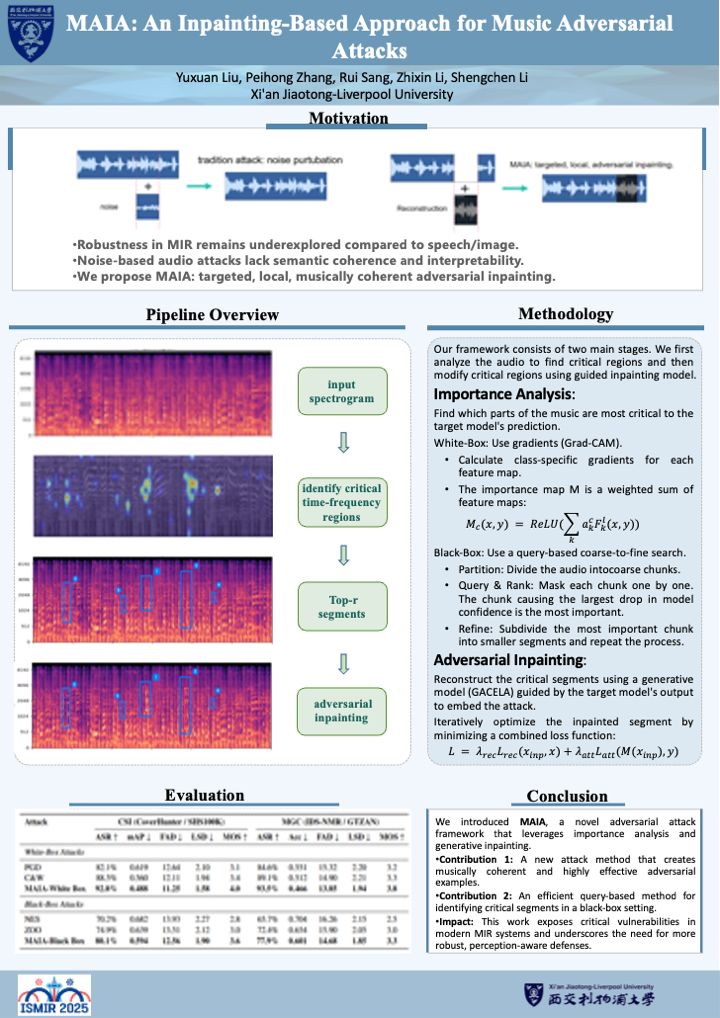
Maia: An inpainting-based approach for music adversarial attacks
Yuxuan Liu*, Peihong Zhang*, Rui Sang, Zhixin Li, Shengchen Li (* equal contribution)
The 26th International Society for Music Information Retrieval Conference (ISMIR) 2025
Music adversarial attacks have garnered significant interest in the field of Music Information Retrieval (MIR). In this paper, we present Music Adversarial Inpainting Attack (MAIA), a novel adversarial attack framework that supports both white-box and black-box attack scenarios. MAIA begins with an importance analysis to identify critical audio segments, which are then targeted for modification. Utilizing generative inpainting models, these segments are reconstructed with guidance from the output of the attacked model, ensuring subtle and effective adversarial perturbations. We evaluate MAIA on multiple MIR tasks, demonstrating high attack success rates in both white-box and black-box settings while maintaining minimal perceptual distortion. Additionally, subjective listening tests confirm the high audio fidelity of the adversarial samples. Our findings highlight vulnerabilities in current MIR systems and emphasize the need for more robust and secure models.
Maia: An inpainting-based approach for music adversarial attacks
Yuxuan Liu*, Peihong Zhang*, Rui Sang, Zhixin Li, Shengchen Li (* equal contribution)
The 26th International Society for Music Information Retrieval Conference (ISMIR) 2025
Music adversarial attacks have garnered significant interest in the field of Music Information Retrieval (MIR). In this paper, we present Music Adversarial Inpainting Attack (MAIA), a novel adversarial attack framework that supports both white-box and black-box attack scenarios. MAIA begins with an importance analysis to identify critical audio segments, which are then targeted for modification. Utilizing generative inpainting models, these segments are reconstructed with guidance from the output of the attacked model, ensuring subtle and effective adversarial perturbations. We evaluate MAIA on multiple MIR tasks, demonstrating high attack success rates in both white-box and black-box settings while maintaining minimal perceptual distortion. Additionally, subjective listening tests confirm the high audio fidelity of the adversarial samples. Our findings highlight vulnerabilities in current MIR systems and emphasize the need for more robust and secure models.
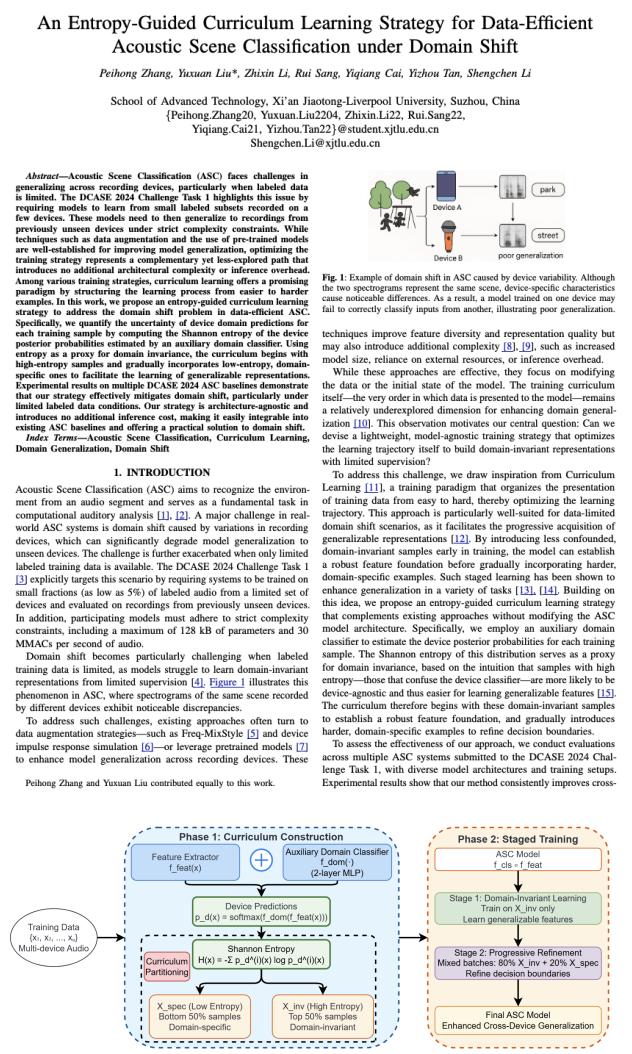
An Entropy-Guided Curriculum Learning Strategy for Data-Efficient Acoustic Scene Classification under Domain Shift
Peihong Zhang*, Yuxuan Liu*, Zhixin Li, Rui Sang, Yiqiang Cai, Yizhou Tan, Shengchen Li (* equal contribution)
Workshop on Detection and Classification of Acoustic Scenes and Events (DCASE Workshop) 2025
Acoustic Scene Classification (ASC) faces challenges in generalizing across recording devices, particularly when labeled data is limited. The DCASE 2024 Challenge Task 1 highlights this issue by requiring models to learn from small labeled subsets recorded on a few devices. These models need to then generalize to recordings from previously unseen devices under strict complexity constraints. While techniques such as data augmentation and the use of pre-trained models are well-established for improving model generalization, optimizing the training strategy represents a complementary yet less-explored path that introduces no additional architectural complexity or inference overhead. Among various training strategies, curriculum learning offers a promising paradigm by structuring the learning process from easier to harder examples. In this work, we propose an entropy-guided curriculum learning strategy to address the domain shift problem in data-efficient ASC. Specifically, we quantify the uncertainty of device domain predictions for each training sample by computing the Shannon entropy of the device posterior probabilities estimated by an auxiliary domain classifier. Using entropy as a proxy for domain invariance, the curriculum begins with high-entropy samples and gradually incorporates low-entropy, domainspecific ones to facilitate the learning of generalizable representations. Experimental results on multiple DCASE 2024 ASC baselines demonstrate that our strategy effectively mitigates domain shift, particularly under limited labeled data conditions. Our strategy is architecture-agnostic and introduces no additional inference cost, making it easily integrable into existing ASC baselines and offering a practical solution to domain shift.
An Entropy-Guided Curriculum Learning Strategy for Data-Efficient Acoustic Scene Classification under Domain Shift
Peihong Zhang*, Yuxuan Liu*, Zhixin Li, Rui Sang, Yiqiang Cai, Yizhou Tan, Shengchen Li (* equal contribution)
Workshop on Detection and Classification of Acoustic Scenes and Events (DCASE Workshop) 2025
Acoustic Scene Classification (ASC) faces challenges in generalizing across recording devices, particularly when labeled data is limited. The DCASE 2024 Challenge Task 1 highlights this issue by requiring models to learn from small labeled subsets recorded on a few devices. These models need to then generalize to recordings from previously unseen devices under strict complexity constraints. While techniques such as data augmentation and the use of pre-trained models are well-established for improving model generalization, optimizing the training strategy represents a complementary yet less-explored path that introduces no additional architectural complexity or inference overhead. Among various training strategies, curriculum learning offers a promising paradigm by structuring the learning process from easier to harder examples. In this work, we propose an entropy-guided curriculum learning strategy to address the domain shift problem in data-efficient ASC. Specifically, we quantify the uncertainty of device domain predictions for each training sample by computing the Shannon entropy of the device posterior probabilities estimated by an auxiliary domain classifier. Using entropy as a proxy for domain invariance, the curriculum begins with high-entropy samples and gradually incorporates low-entropy, domainspecific ones to facilitate the learning of generalizable representations. Experimental results on multiple DCASE 2024 ASC baselines demonstrate that our strategy effectively mitigates domain shift, particularly under limited labeled data conditions. Our strategy is architecture-agnostic and introduces no additional inference cost, making it easily integrable into existing ASC baselines and offering a practical solution to domain shift.