SceneGuard
Training-Time Voice Protection with Scene-Consistent Audible Background Noise
用场景一致的可听背景噪声进行训练时语音保护
AAAI-26 Workshop on Artificial Intelligence for Cyber Security (AICS) · Accepted已接收 · First author· 第一作者
SceneGuard protects published speech by adding scene-matched audible noise whose timing and strength are optimized to reduce speaker-identity similarity while preserving intelligibility.
SceneGuard 通过添加与录音场景匹配的可听噪声来保护已发布语音;噪声的时序与强度经过优化,以降低说话人身份相似度,同时尽量保持可懂度。
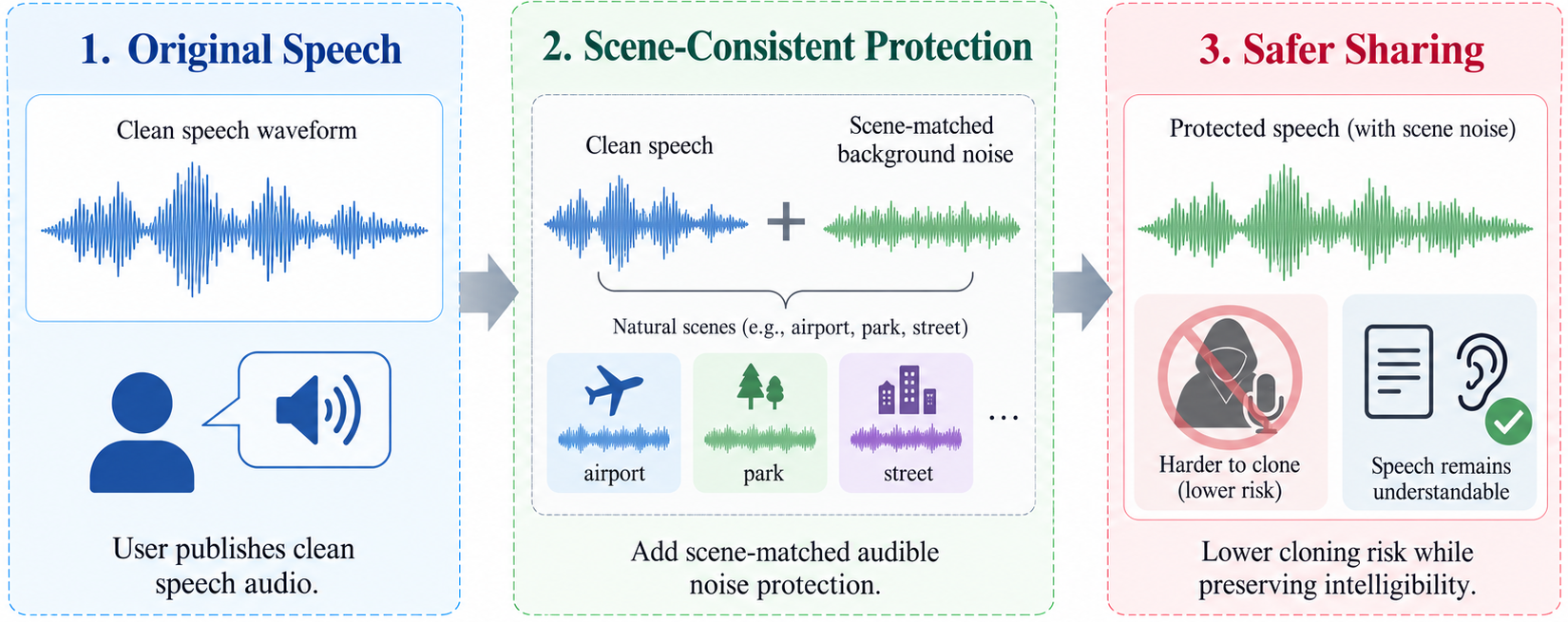
What SceneGuard does
SceneGuard 做什么
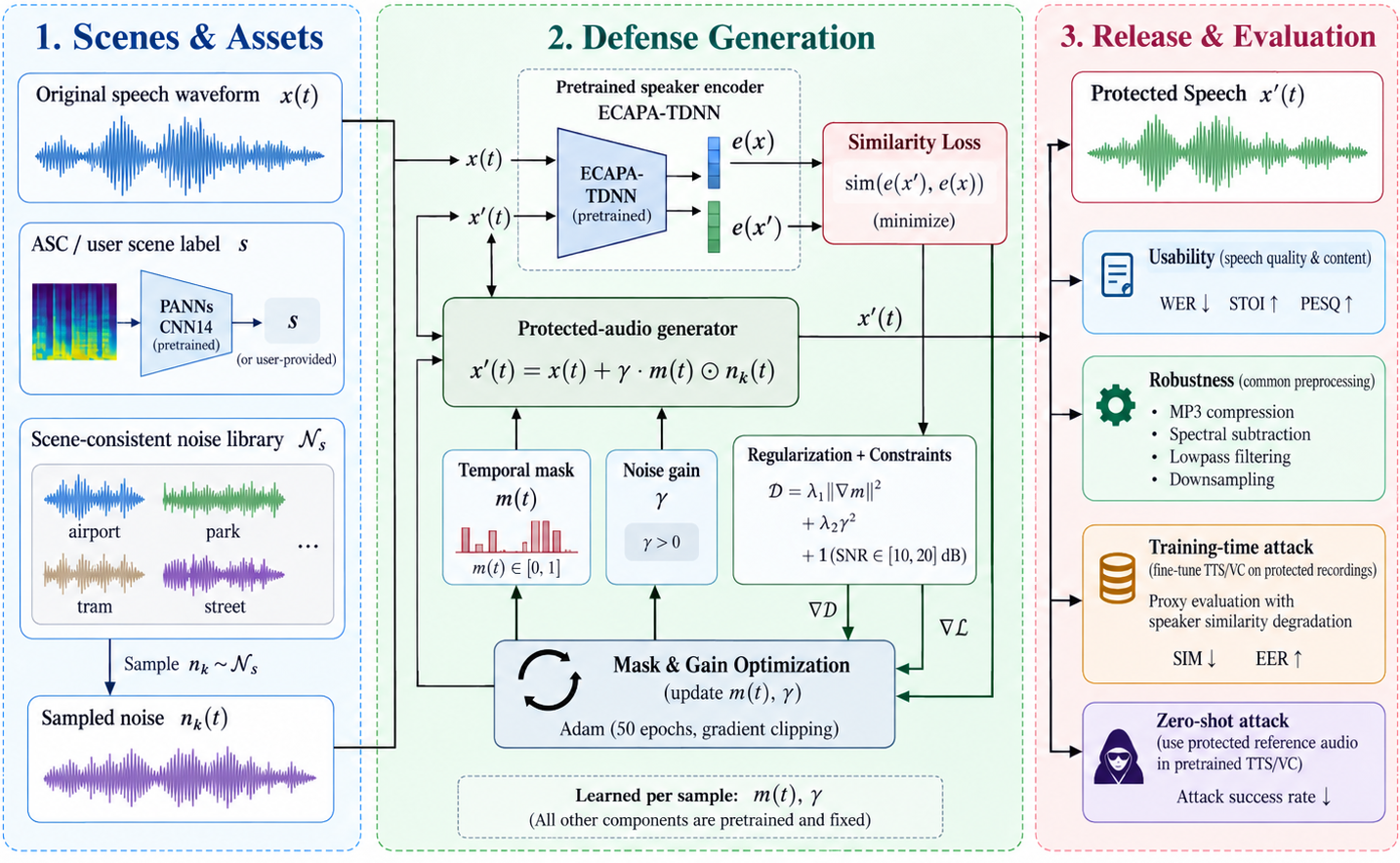
Speech + scene context
语音 + 场景上下文
Speech \(x(t)\), an acoustic scene \(s\), and a scene-specific noise library \(\mathcal{N}_s\).
语音 \(x(t)\)、声学场景 \(s\),以及该场景对应的噪声库 \(\mathcal{N}_s\)。
Protected speech
受保护语音
An audio signal \(x'(t)\) containing audible noise selected to match the recording context.
带有可听噪声的音频信号 \(x'(t)\),噪声按录音场景选取。
Reduce speaker identity
降低说话人身份信息
Lower ECAPA speaker similarity while retaining speech intelligibility and practical usability.
降低 ECAPA 说话人相似度,同时尽量保持可懂度与可用性。
Optimize placement + strength
优化投放位置与强度
Learn a temporal mask \(m(t)\) and global gain \(\gamma\) for a scene-matched noise sample.
为场景匹配噪声学习时间掩码 \(m(t)\) 与全局增益 \(\gamma\)。
Audio demo
音频演示
The comparison interface is ready for curated Clean / Baseline / SceneGuard samples, with matching waveforms and mel spectrograms.
对比界面已预留 Clean / Baseline / SceneGuard 样本位置,并配套波形图与 Mel 频谱。
Clean
Original speech before protection.保护前的原始语音。
Random / Gaussian baseline
A matched-SNR additive-noise baseline.匹配 SNR 的加性噪声基线。
SceneGuard
Scene-conditioned noise with optimized mask and gain.场景条件噪声,掩码与增益经过优化。
Demo assets pending.演示音频待补充。 No redistributable SceneGuard demo audio is currently available in the public repository.公开仓库目前没有可再分发的 SceneGuard 演示音频。 This structure will activate after sample provenance and redistribution rights are documented.在样本来源与再分发权限确认后再启用实际音频。
Protecting speech before an attacker collects it
在攻击者收集之前保护语音
Imperceptible perturbation
不可感知扰动
Prior proactive defenses often constrain perturbations to be difficult to hear, but such low-energy signals may be vulnerable to compression, filtering, or purification.
已有主动防御常把扰动限制为难以听见,但这类低能量信号可能容易被压缩、滤波或净化去掉。
Scene-matched audible protection
场景匹配的可听保护
SceneGuard trades strict imperceptibility for context-aware noise selection and tests whether protection persists under common preprocessing operations.
SceneGuard 用场景感知的噪声选择换取不再追求严格不可听,并检验保护是否能在常见预处理后仍然有效。
Paper-described threat model Full end-to-end BERT-VITS2 fine-tuning was not performed because of computational constraints; speaker-embedding degradation is used as a proxy, complemented by a zero-shot evaluation.因计算资源限制,未做完整端到端 BERT-VITS2 微调;说话人嵌入退化作为代理指标,并辅以 zero-shot 评估。
Input → output
输入 → 输出
x(t)
clean input speech干净输入语音
s
predicted or user-provided scene预测或用户指定的场景
n_k(t)
noise sampled from the scene library从场景噪声库采样的噪声
m(t)
temporal mask in \([0,1]^T\)时间掩码,取值 \([0,1]^T\)
γ
global noise strength全局噪声强度
x'(t)
protected speech output受保护语音输出
Pretrained perception, per-sample optimization
预训练感知模块,按样本优化
PANNs, ECAPA-TDNN, and Whisper are pretrained components. SceneGuard does not train them; gradients update only the temporal mask and global gain for each sample.
PANNs、ECAPA-TDNN 和 Whisper 都是预训练组件。SceneGuard 不训练它们;梯度只更新每个样本的时间掩码与全局增益。
Why optimize the mixture?
为什么要优化混合过程?
Fixed / unoptimized placement
固定、未优化的投放
SIM 0.972 · STOI 0.989 · WER 3.2%
Learned mask + constrained gain
学习掩码 + 受约束增益
SIM 0.945 · STOI 0.986 · WER 3.6%
Paper Table 6 Optimization improves reported similarity degradation by 2.7 percentage points under the same SNR constraint, with a 0.003 STOI decrease and 0.4-point WER increase.在相同 SNR 约束下,优化使报告的相似度下降提高 2.7 个百分点;STOI 仅下降 0.003,WER 上升 0.4 个百分点。
What is actually optimized?
实际优化了什么?
General paper formulation and disabled terms论文一般形式与默认关闭项
In the default experiments, \(\lambda_{\mathrm{ASR}}=0\) and \(\lambda_{\mathrm{SCN}}=0\). Scene consistency is introduced mainly by selecting noise from the scene-specific library; usability is enforced primarily through SNR and evaluated after optimization.
默认实验中 \(\lambda_{\mathrm{ASR}}=0\)、\(\lambda_{\mathrm{SCN}}=0\)。场景一致性主要靠从对应噪声库取样来引入;可用性主要靠 SNR 约束保证,并在优化后评估。
Four views of the protection–quality trade-off
保护与质量权衡的四个视角
Protection
保护效果
Speaker Similarity (SIM) ↓
Cosine similarity between speaker embeddings.说话人嵌入之间的余弦相似度。
Usability
可用性
WER ↓ · STOI ↑ · PESQ ↑
Transcription, intelligibility, and objective quality.转写、可懂度与客观音质。
Robustness
鲁棒性
SIM after preprocessing
MP3, spectral subtraction, low-pass, and downsampling.MP3、谱减、低通与降采样。
Zero-shot
SIM + success rate ↓
Cloning with clean versus protected reference audio.分别用干净参考与受保护参考做克隆。
Main comparison
主要对比
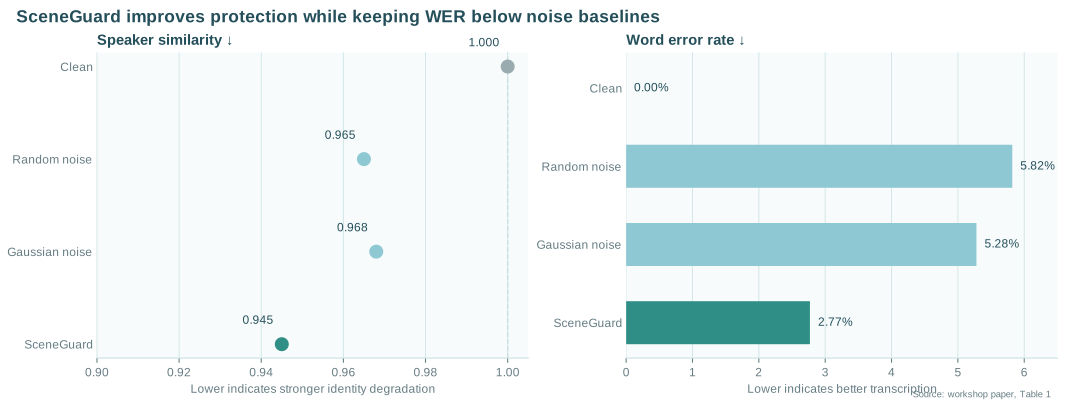
View exact values from Paper Table 1查看 Paper Table 1 精确数值
| Training data训练数据 | SIM ↓ | WER (%) ↓ | PESQ ↑ | STOI ↑ |
|---|---|---|---|---|
| Clean | 1.000 | 0.00 | 4.64 | 1.00 |
| Random noise | 0.965 | 5.82 | 1.85 | 0.97 |
| Gaussian noise | 0.968 | 5.28 | 1.92 | 0.98 |
| SceneGuard | 0.945 | 2.77 | 2.22 | 0.99 |
Paper Tables 1–2 Table 1 reports WER 2.77% and PESQ 2.22; the separate usability summary reports WER 3.60% and PESQ 2.034. The paper does not document why the summaries differ, so they are shown separately.Table 1 报告 WER 2.77%、PESQ 2.22;单独的可用性摘要报告 WER 3.60%、PESQ 2.034。论文未说明两组摘要为何不同,因此分开展示。
SNR trade-off explorer
SNR 权衡查看器
Move across the four precomputed settings to inspect the reported protection–usability balance.
在四个预计算结果之间切换,查看论文报告的保护与可用性权衡。
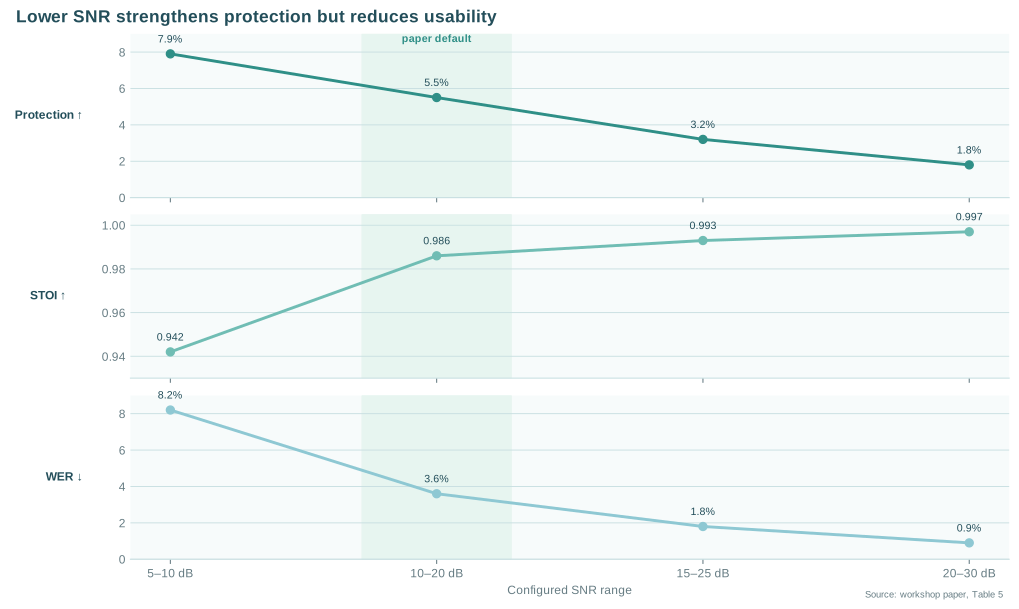
Visualization of paper-reported, precomputed ablation results—no model inference runs in the browser.这是论文报告的预计算消融可视化,浏览器中不运行模型推理。
Protection after common preprocessing
常见预处理后的保护效果
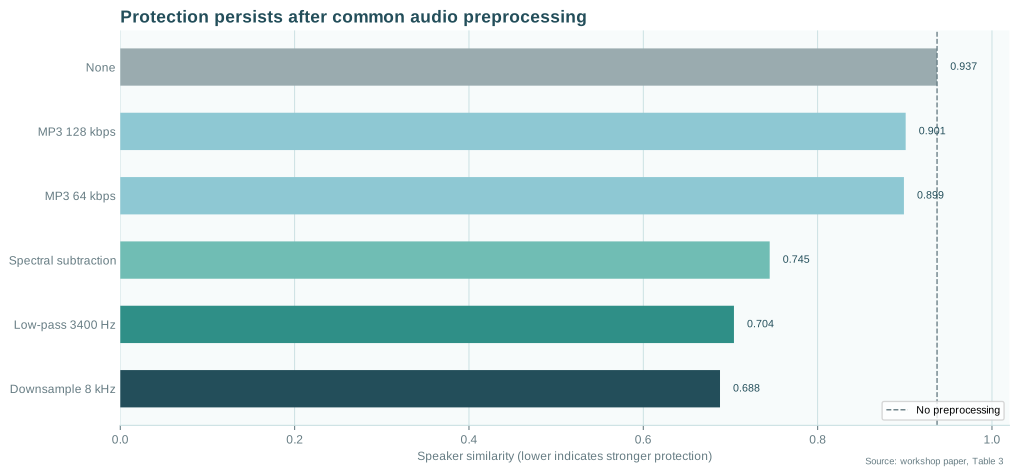
Paper Table 3 Lower SIM indicates greater speaker-identity degradation. The public repository does not contain the per-sample files needed for independent recomputation.更低的 SIM 表示说话人身份退化更强。公开仓库目前没有可供独立复算的逐样本文件。
Protected reference audio lowers reported cloning similarity
受保护参考音频会降低报告的克隆相似度
Paper Table 4 No publishable zero-shot synthesized audio or raw result file is present in the public repository, so this section reports metrics only.公开仓库没有可发布的 zero-shot 合成音频或原始结果文件,因此本节只报告指标。
Implementation details
实现细节
| Scene classifier场景分类器 | PANNs CNN14, pretrained on AudioSet |
|---|---|
| Speaker encoder说话人编码器 | ECAPA-TDNN, 192-dimensional embeddings |
| ASR evaluatorASR 评估器 | Whisper Base |
| Referenced TTS architecture参考 TTS 架构 | BERT-VITS2; no full fine-tuning in the workshop experimentBERT-VITS2;workshop 实验中未做完整微调 |
| Optimizer优化器 | Adam, learning rate 0.01 |
| Default optimization默认优化设置 | 50 epochs, gradient clipping max norm 1.0 |
| Default SNR默认 SNR | 10–20 dB |
| Reported runtime报告运行时间 | Approximately 10–15 s/sample on one RTX A6000单张 RTX A6000 上约 10–15 秒/样本 |
| Speech / noise data语音 / 噪声数据 | LibriTTS; TAU Urban Acoustic Scenes 2022 |
| Noise library噪声库 | Approximately 50,000 three-second clips across 10 scene categories约 50,000 条 3 秒片段,覆盖 10 类场景 |
| Training-attack split训练攻击划分 | 100 training samples and 40 test samples100 条训练样本,40 条测试样本 |
Evidence boundary
证据边界
Public pipeline
公开流程
Evidence boundary Paper tables are the source for the numerical results on this page. Values such as negative final speaker similarity and very low SNR variance from the README are excluded because their dataset/configuration cannot be traced to public artifacts.本页数值以论文表格为准。README 中无法追溯到公开实验设置的结果(例如负的最终说话人相似度、极低 SNR 方差)未采用。